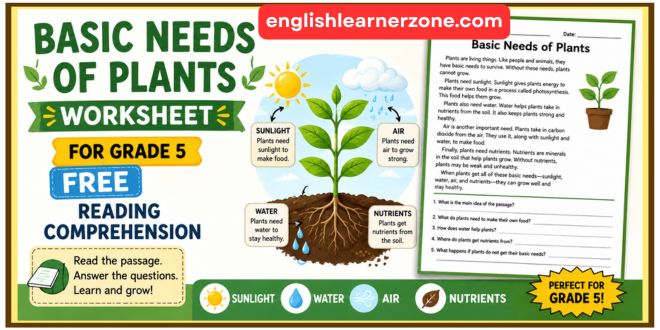
If you are looking for a fun and educational way to teach plant science, this Basic Needs of Plants Worksheet for Grade 5 Free Reading Comprehension is a great resource for your classroom or homeschool lessons.
This worksheet helps students learn about the basic needs of plants, including sunlight, water, air, nutrients, soil, space, and temperature, through an engaging informational reading passage and standards-based comprehension activities.
Designed for 5th-grade students, this free science reading comprehension worksheet combines Life Science and ELA skills into a single meaningful activity. Students will practice reading an informational text and answering different comprehension questions.
Basic Needs of Plants Worksheet for Grade 5 Free Reading Comprehension
Here is the passage:
The Basic Needs of Plants
Plants are living things that need certain things to live and grow. Like people and animals, plants have basic needs. They need sunlight, water, air, nutrients, soil, space, and the right temperature to stay healthy.
Sunlight is one of the most important needs of plants. Plants use energy from the sun to make their own food in a process called photosynthesis. During photosynthesis, plants take in water from the soil through their roots and carbon dioxide from the air through tiny holes in their leaves. Then, they use sunlight to make sugar for food and release oxygen into the air. Most photosynthesis happens in the leaves because they contain chlorophyll, a green substance that absorbs sunlight.
Plants also need water and nutrients to grow well. The roots absorb water and minerals from the soil and carry them to the rest of the plant. Nutrients such as nitrogen, phosphorus, and potassium help plants grow strong roots, stems, and leaves. Without enough water or nutrients, plants can become weak or stop growing.
Plants also need air and enough space to grow. They need carbon dioxide from the air to make food. Their roots need room to spread, and their leaves need space to get sunlight. Most plants also grow best at the right temperature. If it becomes too hot or too cold, plants may not survive. When plants get everything they need, they can grow healthy, produce flowers and seeds, and provide food and oxygen for living things on Earth.
Comprehension Questions
Exercise 1: Choose the correct answer.
- What do plants use to make their own food?
a) Moonlight
b) Wind
c) Sunlight
d) Rain - Which part of the plant absorbs water from the soil?
a) Flowers
b) Roots
c) Leaves
d) Seeds - What do plants release into the air during photosynthesis?
a) Oxygen
b) Soil
c) Minerals
d) Carbon dioxide - Why do plants need nutrients?
a) To change color
b) To grow strong roots, stems, and leaves
c) To move from place to place
d) To make the weather cooler - What may happen if plants do not have enough space?
a) Their roots and leaves may not grow properly
b) They may stop needing water
c) They may grow faster
d) They may produce less oxygen immediately
Exercise 2: Write True or False.
- Plants need water to survive. ——
- Photosynthesis mainly takes place in the roots. ——-
- Chlorophyll is a green substance in leaves. ——-
- Plants take in carbon dioxide from the air. ——-
- Very hot or very cold temperatures can harm plants. ——-
Exercise 3: Choose the correct meaning of the words in bold.
- “Plants need certain things to survive and grow.”
a) stay alive
b) fall down
c) dry out
d) disappear - “The roots absorb water and minerals from the soil.”
a) throw away
b) take in
c) cut off
d) break apart - “Plants release oxygen into the air.”
a) keep inside
b) collect
c) let out
d) cover up - “Plants may become weak or wilt.”
a) become dry and droopy
b) grow taller
c) turn blue
d) produce seeds
Exercise 4: Answer the following questions
1.What process helps plants make their own food?
…………………………………………………………………………………………………………………………
2.Where does most photosynthesis happen in a plant?
………………………………………………………………………………………………………………………
3. Why do plants need carbon dioxide?
……………………………………………………………………………………………………………………..
4. How do roots help plants?
………………………………………………………………………………………………………………..
5. When do plants grow healthy and produce flowers and seeds?
……………………………………………………………………………………………………………..
You may also like: